Home › Blog › Carrom Versus Pool: The Real Differences
Carrom Versus Pool: The Real Differences
Last updated: October 6, 2026
Carrom versus pool differences come down to contact method — a finger-flicked striker versus a pushed cue — which shapes everything else about pockets, players, and strategy in each game.
Published · Updated
Quick answer
Carrom versus pool differences start with contact: carrom uses a finger-flicked striker on a flat board, while pool uses a cue pushed to roll balls on a cloth table. That difference shapes pockets, player count, and which skills matter most.
Key takeaways
- Carrom uses a finger-flicked striker; pool uses a cue pushed in a straight line.
- Carrom has four corner pockets; pool spreads pockets around every rail.
- Carrom boards are square with a 74 x 74 cm playing surface; pool tables are long and rectangular.
- Carrom plays two or four in teams; pool is usually one-on-one.
- Neither game is harder overall — the hard parts just sit in different places.
The core of carrom versus pool differences comes down to contact: carrom is played by flicking a striker across a flat powdered board with your finger, while pool is played by pushing a cue to roll balls across a cloth-covered table. Everything else — the scoring, the pockets, the feel of a good shot — follows from that one contact difference.
What's actually different between carrom and pool?
The biggest gap is how you make contact with the piece that does the work. In carrom, you snap a striker — a flat disc weighing 15 grams — with your finger, and it skids across a board dusted with powder to knock flat coins into one of the four corner pockets. In pool, you push a cue against a cue tip to roll a round ball across cloth and into pockets set around the rails of a long table.
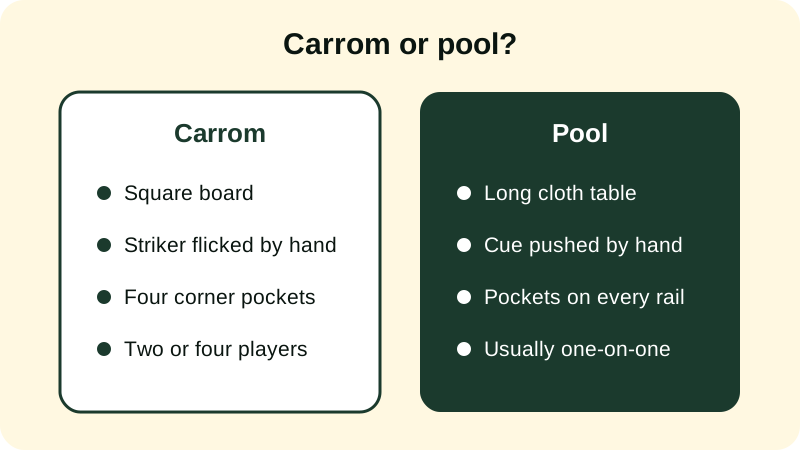
Carrom is played on a square board with a 74 x 74 cm playing surface, with 19 coins on it at the start — 9 white, 9 black, and 1 red queen — and either two players or four players split into two teams. Pool uses a longer rectangular table, a set of rolling balls, and is usually a one-on-one game, which already changes how much ground each turn has to cover.
Carrom pockets vs pool pockets is its own small puzzle. Carrom only gives you four pockets, all tucked into the corners, which forces more angled shots since there's nowhere to aim along the sides. Pool spreads pockets around the whole rail, which opens up more straight-line options but also means covering a lot more table with every shot.
| Feature | Carrom | Pool |
|---|---|---|
| Surface | Square board, 74 x 74 cm playing surface | Long rectangular cloth table |
| Contact piece | Striker, 15 grams, flicked by finger | Cue stick, pushed by hand |
| Target pieces | 19 coins: 9 white, 9 black, 1 red queen | A set of numbered balls |
| Pockets | Four corner pockets | Pockets at corners and sides |
| Players | Two players, or four in two teams | Usually one-on-one |
How do carrom strikers vs pool cues actually compare?
A striker and a cue do the same job — they transfer your energy into the game — but they behave nothing alike. A striker is a small, flat disc you flick with your finger, so all your control comes from wrist and finger tension in a fraction of a second. A cue is a long stick you draw back and push forward in a straight line, so your control comes from a slower, more deliberate stroke along a fixed path.
That difference shows up in how forgiving each game is. A slightly sloppy cue stroke in pool often still sends the ball roughly where you meant, because the stick constrains the direction. A slightly sloppy flick in carrom can send the striker off at a noticeably different angle, because nothing is guiding it but your finger and your aim. That's part of why carrom rewards a steady, repeatable striker technique so heavily — small inconsistencies show up immediately.
Is carrom harder than pool to learn?
Neither game is objectively harder — they're difficult in different places. Carrom's challenge is mostly in the flick itself, since getting a consistent, controlled strike with just your finger takes longer to groove than most people expect, while pool's challenge is mostly in reading the table across a longer playing surface.
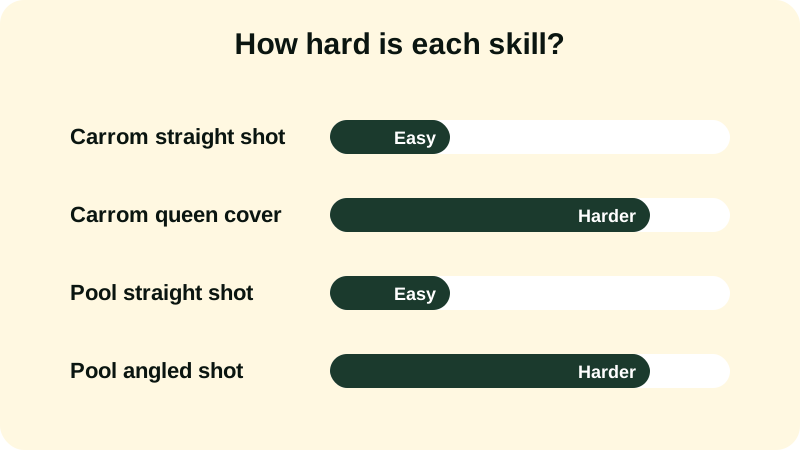
If you're comparing total time to real competence, most people pick up basic carrom faster, simply because the board is smaller and the straight shots are more forgiving early on. Pool's longer table and the extra step of reading cue-ball spin tends to stretch out the learning curve, even if the very first shots in both games feel about the same. Neither advantage lasts, though — both games have a long runway from "can hit the target" to "can plan three shots ahead."
Do carrom and pool reward the same kind of strategy?
Partly. Both games reward thinking one shot ahead instead of just aiming at the nearest target — in carrom that often means leaving your striker in a useful position after the shot, and in pool the same idea applies to the cue ball. Both also punish players who always go for the hardest, flashiest option instead of the safe, available one.
Where they diverge is pacing and structure. Carrom's turn can keep going as long as you keep pocketing your own coins, which rewards streaks and momentum — and with four players split into two teams, that rhythm turns into a doubles conversation, not just a solo one. Pool's turn structure depends on which balls you're assigned and clearing them in order, which rewards planning a sequence rather than chasing one good shot at a time.
If you want to drill carrom angles and queen covers without setting up a full board every time, Carrom is a mobile version of the game currently in development, with real physics, AI opponents, and board and striker cosmetics planned — the goal is no pay-to-win in online multiplayer, so nothing you unlock gives an edge over a real opponent. It isn't released yet, but you can get notified when it launches.
At the end of the day, carrom and pool are closer cousins than people assume — both are about pocketing pieces with precision and patience — but the physical skill is different enough that being great at one doesn't make you great at the other. Learn the flick on its own terms, and the pool table will still be there waiting whenever you want a change of pace.
Frequently asked questions
Is carrom harder than pool to learn?
Neither is harder overall. Carrom's difficulty is in the flick — getting a consistent finger strike takes real practice — while pool's difficulty is in reading a longer table, judging angles, and controlling spin. Most people find basic carrom shots easier to start with, since the board is smaller and more forgiving early on.
What's the main difference between a carrom striker and a pool cue?
A striker is a flat disc you flick with your finger in a fraction of a second, so control comes from your wrist and finger tension. A pool cue is a long stick pushed in a slower, guided straight-line stroke, which makes a slightly sloppy shot more forgiving than in carrom.
Do carrom and pool use the same number of pockets?
No. Carrom has four corner pockets only, which forces more angled shots since there's nothing to aim at along the sides. Pool spreads pockets around the whole rail — at the corners and along the sides — which opens up more straight-line shot options.
Can the same strategy skills transfer between carrom and pool?
Some do. Both games reward planning one shot ahead and leaving your striker or cue ball in a useful spot rather than chasing the nearest target. But the physical motion is different enough — a flick versus a guided push — that being skilled at one doesn't automatically carry over to the other.
Is the Carrom app useful for practicing before switching to pool?
Carrom, a mobile version of the board game, is in development and not released yet, with plans for realistic physics, AI opponents, and no pay-to-win in online multiplayer. It won't teach you pool, but practicing carrom's finger-flick technique could sharpen the same touch and patience pool also rewards.