Home › Blog › Carrom Striker Weight and Size: What Actually Matters
Carrom Striker Weight and Size: What Actually Matters
Last updated: October 7, 2026
A regulation carrom striker weighs 15 grams and must be clearly wider than the coins, and getting either number wrong throws off shots that otherwise look perfectly lined up.
Published · Updated
Quick answer
Carrom striker weight and size follow one standard: a regulation striker weighs 15 grams and sits noticeably wider than any coin, and both figures shape how cleanly it contacts coins and carries through a shot.
Key takeaways
- A regulation carrom striker weighs 15 grams — match this when replacing a lost one.
- A striker must be clearly wider than coins with a smooth, evenly rounded edge.
- Heavier feel carries through clusters; lighter feel suits delicate taps.
- In doubles, one team should agree on a single striker for the whole game.
- A nicked edge or mismatched weight is often blamed on aim instead of equipment.
Carrom striker weight and size both matter more than most players realize: a regulation striker weighs 15 grams and sits noticeably wider than any coin on the board. Get either one wrong and shots that look perfectly lined up start behaving strangely.
What's the standard carrom striker weight?
A regulation carrom striker weighs 15 grams. That's light enough to flick with a quick snap of the finger, but heavy enough to carry through a cluster of coins without bouncing off at a strange angle. This weight is the baseline most boards and striker sets are built around, so if you're replacing a lost or cracked striker, matching it is what keeps your shots feeling familiar instead of mysteriously different.
Weight consistency matters more than players expect. A striker that's even a little lighter than what you're used to will feel quick and skittish, sliding further than you intend on a shot you'd normally judge perfectly. A heavier one feels sluggish by comparison, and you'll find yourself overcompensating with more force than the shot actually needs. Even experienced players get thrown off by a swapped striker, because so much of carrom touch is built on muscle memory tuned to one specific weight.
How big should a carrom striker be compared to the coins?
A striker needs to be clearly wider than the coins it's hitting, with a smooth, evenly rounded edge all the way around.
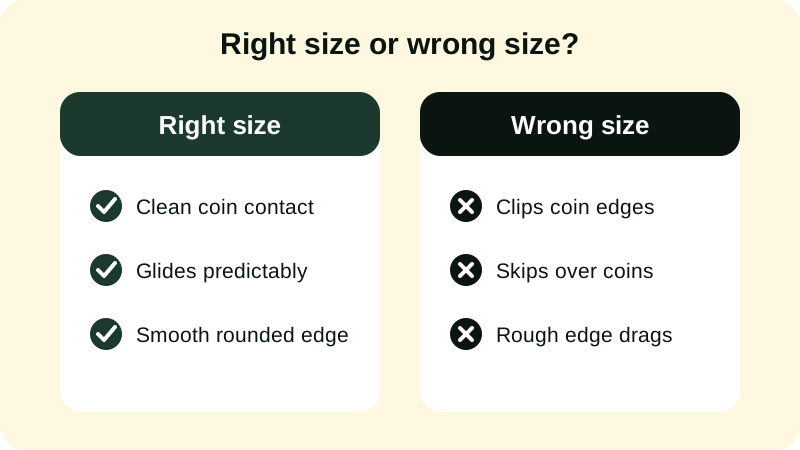
That size difference is what lets a striker make full contact with a coin instead of glancing off the top or clipping a corner — a striker too close in size to a coin behaves unpredictably even when your aim is perfect. Run a finger along the edge of any striker before you trust it in a real game. A nick or flat spot changes how it rolls off a coin, and that tiny imperfection is easy to mistake for a bad shot instead of a bad striker.
The board surface it's sliding across matters just as much as the striker itself, so it's worth pairing this with the board maintenance guide to keep the surface playing fast and consistent. It also helps to think about striker size relative to the whole board setup, not just one coin. With 19 coins packed into the center at the start of a game, the striker has to thread through tight gaps on a break-style opening shot, and a correctly sized striker makes that attempt far more predictable. If you haven't looked at how those coins get arranged in the first place, the coin placement diagram is a useful companion to this guide.
Does striker weight actually change how a shot behaves?
Yes, and the difference is bigger than most beginners expect.
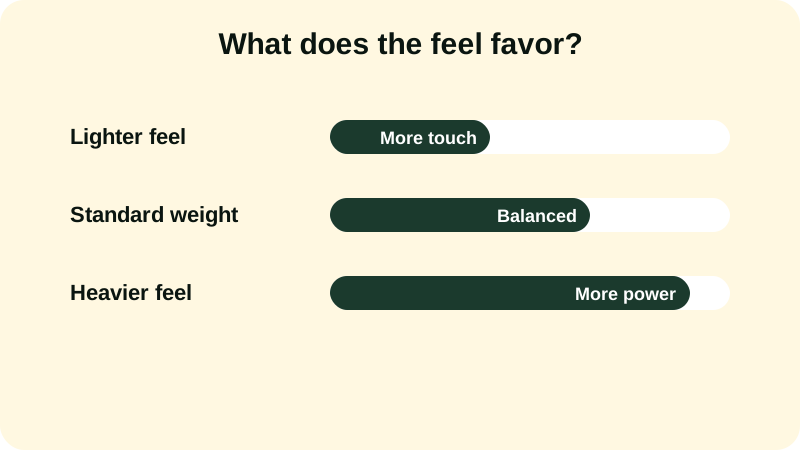
A heavier-feeling striker carries through a crowded board more easily, pushing past one coin to reach another without losing much energy. A lighter-feeling one is easier to control for touch shots and gentle taps, but it gets knocked off its line more easily when it clips something on the way to its target. Mixing strikers mid-match causes problems you might not immediately connect to the equipment. If you're sharing a board with friends and everyone brings their own striker, the feel of the game changes every time the striker changes hands, which makes it genuinely harder to judge distance consistently.
If you're still building out your basic technique, it's worth pairing this with a look at how carrom's core rules and setup work before worrying too much about equipment nuances.
Does striker weight matter more when you're playing doubles?
It does, because in doubles a striker often gets handed between two players on the same team across a single game. If one partner is used to a slightly heavier feel and the other prefers something lighter, neither of them gets to fully settle into their own touch — every handoff resets the calibration a little. Agreeing on one striker for the whole team before the game starts removes that extra variable and lets both players focus on strategy instead of relearning the feel of the equipment mid-match.
The same logic applies to casual tournament-style play among friends: pick one striker for the whole session and stick with it, even if someone has a personal favorite they'd rather use. Consistency across turns matters more than any single player's preference, especially once the board gets crowded and shots demand precise touch. For more on how teams coordinate shot selection and turn order, the doubles rules guide covers the strategy side in more depth.
How do you pick the right striker for your own game?
Start by matching the standard weight and checking the edge is smooth and evenly rounded — those two things alone solve most striker problems before you even think about personal preference. From there, it comes down to feel: some players like a slightly heavier striker for power shots and breaks, while others prefer something lighter for precise, short-distance taps and covering a crowded board.
Keep a couple of strikers in similar condition so you always have a backup that feels the same as the one you've been using, rather than scrambling for a mismatched spare mid-game. If a striker starts feeling different for no obvious reason, check the edge before you check your technique — a worn or chipped striker is a far more common culprit than a sudden loss of form.
Get the weight and size right and most of what feels like inconsistent aim turns out to be solved equipment. For more guides on technique, setup, and getting the most out of every session, browse the rest of the blog.
Frequently asked questions
What is the standard carrom striker weight?
A regulation carrom striker weighs 15 grams. That's light enough to flick with a quick snap of the finger but heavy enough to carry through a cluster of coins without bouncing off at a strange angle, which is why most boards and striker sets are built around this figure.
Why does a carrom striker need to be bigger than the coins?
A striker has to be clearly wider than the coins it's hitting so it can make full contact instead of glancing off the top or clipping a corner. A striker too close in size to a coin behaves unpredictably even when your aim is perfect, especially on crowded shots.
Does a heavier striker help with power shots?
A heavier-feeling striker does carry through a crowded board more easily, pushing past one coin to reach another without losing much energy. But it trades away some of the touch you need for gentle taps, so most players want one consistent weight rather than switching for power alone.
Does striker weight matter more in doubles?
Yes, because a striker is often handed between two teammates across a game. If one partner is used to a heavier feel and the other prefers lighter, neither fully settles into their touch. Agreeing on one striker for the whole team removes that extra variable.