Home › Blog › How to Play Carrom Step by Step: Rules & Setup
How to Play Carrom Step by Step: Rules & Setup
Last updated: September 18, 2026
A clear walkthrough of how to play carrom step by step — board setup, coin count, turn rules, and the queen rule — for anyone who wants to start playing confidently tonight.
Published · Updated
Quick answer
How to play carrom step by step: set up the board, arrange coins around the queen, then take turns flicking the striker from your baseline. Keep pocketing your own color to keep your turn, and cover the queen before claiming it.
Key takeaways
- Each side plays one color; the queen belongs to neither player until it's covered.
- A turn continues only while you keep pocketing your own color cleanly.
- The striker must start every shot from your baseline, not anywhere else.
- Covering the queen means pocketing one of your own coins right after you sink her.
- Carrom works for two players head-to-head or four players in two teams.
Learning how to play carrom step by step comes down to three things: board setup, coin count, and turn order. Get those locked in and the rest of the game is just practice and better aim.
What do you need to set up a game of carrom?
Carrom is played on a square board with a smooth playing surface — a standard one measures 74 x 74 cm — with four corner pockets, one in each corner, that you're trying to sink coins into. The full set of pieces is 19 coins: 9 white coins, 9 black coins, and 1 red queen.
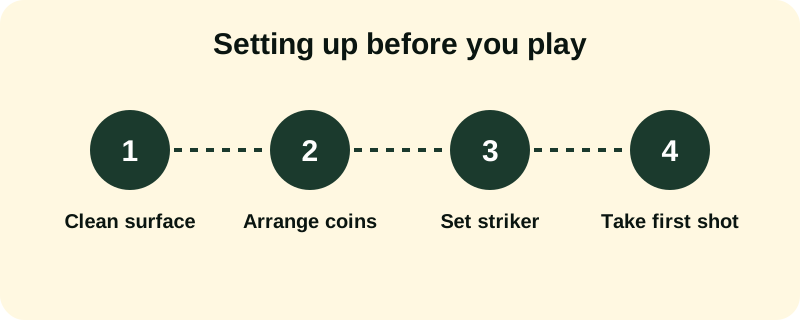
Each player or team plays one color, white or black, and the queen belongs to neither side until someone claims it. Before the first shot, the coins go in the center of the board in a set pattern with the queen in the very middle, surrounded by white and black coins alternating around her. The striker is the piece you actually flick, and it's heavier than the coins — a striker weighs 15 grams — which is why it can knock coins around without following them into the pocket most of the time. Before every shot, the striker has to sit on your base line, the edge of the board closest to you.
If you want the exact layout down to the last coin, there's a full carrom coin placement diagram that walks through the pattern. Once the board is set, the overall flow of a game looks like this:
- Arrange the coins in the center with the queen in the middle, alternating colors around her.
- Decide who shoots first and which color each player or team takes.
- Place the striker on your baseline before every shot — never anywhere else.
- Flick the striker to pocket your own color, and keep shooting as long as you succeed.
- If you pocket the queen, cover her by pocketing one of your own coins on the very next shot.
- Play continues until one side clears its coins and claims the queen.
How many players does carrom need, and who goes first?
Carrom works with two players or with four players split into two teams. In the two-player version, you and your opponent each play one color and alternate turns directly. In the four-player team version, teammates sit on opposite sides of the board rather than next to each other, and turns rotate around the board in order rather than jumping between teammates — there's a full breakdown of how that works in the carrom doubles rules.
Whoever breaks first, and how color gets assigned, usually just comes down to a simple agreement between players before the game starts. What matters more once play is underway is what happens during each turn — that's where most beginners get tripped up.
What are the basic turn rules once play starts?
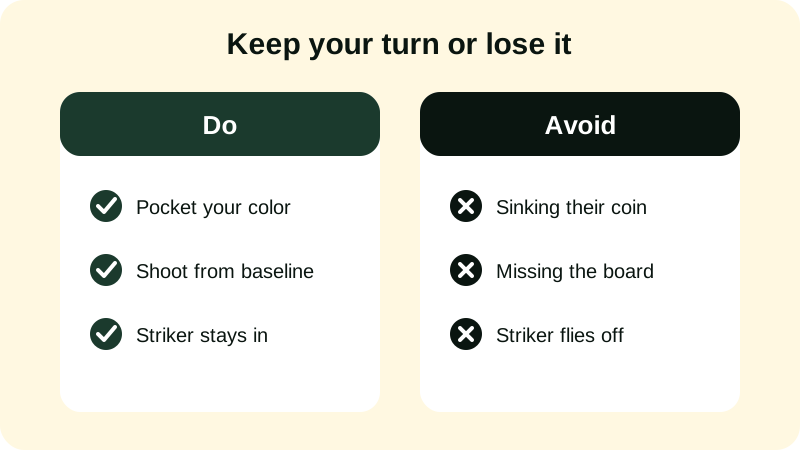
A turn continues as long as you keep pocketing your own color. The moment you pocket an opponent's coin instead, or miss the board entirely, your turn ends and play passes to the other side. This is the single most important habit to build early: aim for precision over power, because a hard shot that clips the wrong coin into a pocket costs you your turn just as fast as a total miss would.
| Situation | What happens |
|---|---|
| You pocket your own coin cleanly | Turn continues |
| You pocket an opponent's coin | Turn ends, play passes over |
| You miss everything on the board | Turn ends |
How does the queen work in carrom?
The red queen is the one coin that trips up almost every beginner, because pocketing it doesn't automatically win it for you. Most rule sets require you to "cover" the queen — meaning you have to pocket one of your own regular coins on a following shot to actually claim it. If you pocket the queen but then fail to cover it, it typically goes back onto the board instead of staying banked.
Stronger players tend to wait until the board has opened up a bit — fewer coins around the queen means a much easier follow-up shot to cover her with. Patience with the queen is one of the fastest ways to look like a more experienced player than you actually are yet.
What shots should a beginner practice first?
Start with straight shots at close range before you try anything with an angle. Line up a single coin sitting near a pocket, place the striker directly opposite it on your base line, and practice a smooth, controlled flick rather than a hard snap. Once that feels automatic, add one bank shot off the side rail — it's the most useful angled shot to learn early, since so many real positions on a crowded board need it.
Pay attention to where the striker ends up after each shot, not just whether the coin went in. A shot that pockets a coin but leaves your striker stranded in a bad spot sets up your opponent for an easy turn right after yours. If your shots keep drifting off-line, the guide on how to aim accurately in carrom goes deeper into sighting and lining up the angle before you flick.
Where can you practice these rules without a full board handy?
Not everyone has a board and a free table set up on a random weeknight, which is a real barrier to getting reps in. Carrom is a mobile carrom game currently in development, built around real physics and real skill, with 5 AI difficulty levels, trick shot puzzles to sharpen specific shots, and local multiplayer for when someone's sitting right next to you. Its online multiplayer is being built with no pay-to-win in online multiplayer — strikers and boards are cosmetic, so nothing you unlock gives you an edge against another real player. It isn't on the App Store or Google Play yet, so get notified on the home page when it launches if you'd like a way to keep your aim sharp between real games.
Once the setup, turns, and queen rules are second nature, the rest of carrom is reps — closer to muscle memory than memorized rules. The blog has more detailed guides on striker technique and board setup if you want to go deeper into any one piece of this.
Frequently asked questions
How many coins are used in a game of carrom?
A standard set has 19 coins: 9 white coins, 9 black coins, and 1 red queen. Each player or team plays one color, while the queen stays neutral until someone pockets it and covers it with their own coin on a following shot.
What happens if you pocket the queen but don't cover it?
If you pocket the queen but fail to pocket one of your own coins on a later shot, the queen usually goes back onto the board instead of staying banked. That's why rushing the queen early, before the board opens up, is a common beginner mistake.
Can carrom be played with four players?
Yes — carrom can be played by two players head-to-head or by four players split into two teams. In the four-player version, teammates sit on opposite sides of the board and turns rotate around the table in order rather than jumping between partners.
What causes a foul in carrom?
The most common beginner foul is letting the striker fly off the board after a shot — if that happens, it typically cancels any coin you pocketed on that same turn. Always check where your striker lands before celebrating a pocketed coin.
Is there a mobile way to practice carrom rules?
Carrom, a mobile carrom game, is in development and not released yet. It's being built with real physics, AI opponents, and local or online multiplayer, with no pay-to-win in online multiplayer. You can get notified at launch on the home page.