Home › Blog › Carrom Coin Placement Diagram: How to Set Up the Board
Carrom Coin Placement Diagram: How to Set Up the Board
Last updated: September 20, 2026
A carrom coin placement diagram centers the 1 red queen inside a tight, alternating ring of 9 white and 9 black coins, and the layout never changes for two players or four players in teams.
Published · Updated
Quick answer
A carrom coin placement diagram puts the 1 red queen in the center with 9 white coins and 9 black coins alternating tightly around her. The layout stays identical for two players or four players in teams — only who's shooting from where changes.
Key takeaways
- The queen sits dead center with 9 white and 9 black coins alternating tightly around her.
- Setup stays identical whether two players or four players in teams are playing.
- A loose or clumped stack creates an unpredictable, unfair opening break.
- Check both baselines before shooting to confirm the ring looks symmetrical.
- All 19 coins fit inside the center circle before the striker ever moves.
A carrom coin placement diagram shows one simple picture: 9 white coins and 9 black coins arranged in a tight alternating ring around the 1 red queen, all packed inside the center circle before the first shot. Get that picture right and the rest of setup takes care of itself.
What does the coin arrangement actually look like?
Picture the center circle as a small target on the board. The queen goes dead in the middle. Around her, the 18 remaining coins — 9 white and 9 black — stack in alternating colors, forming a tight ring so that no two coins of the same color sit directly next to each other where possible. The whole cluster should look like a compact, symmetrical hexagon or circle, not a loose pile.
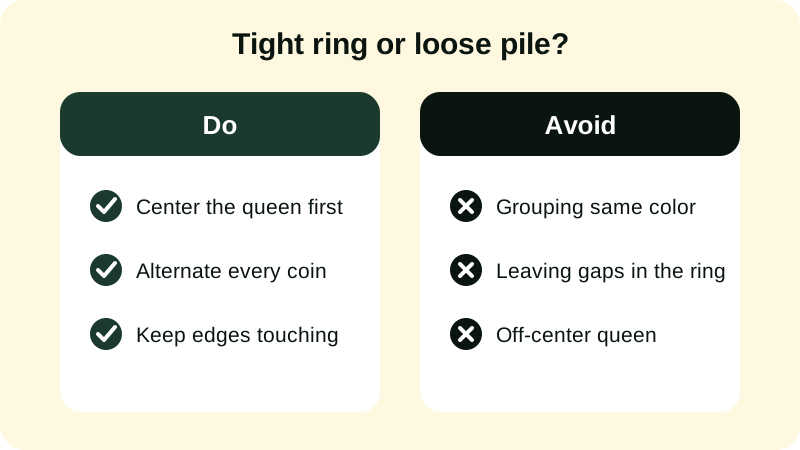
This matters more than it looks like it should. A snug stack means the opening shot — the "break" — scatters coins predictably across the board. A loose or lopsided stack means one side gets flooded with coins and the other opens up too early, changing the flow of the game before either player has taken a real turn.
Here's how most players actually build it, step by step:
- Place the queen first, right in the center of the circle.
- Add coins outward in pairs — one white, one black, alternating as you go.
- Keep the stack tight, coin edges touching, so nothing shifts before the first shot.
- Check it from both sides of the board — it should look identical to both players.
If you're new to the sequence of a full game, not just the setup, this guide to how to play carrom walks through turns, fouls, and scoring from the very first shot onward.
Why does the alternating pattern matter?
Alternating white and black keeps the setup fair. If you accidentally group all your coins together, you're handing your opponent's coins a clear path to their own pockets while yours sit clumped and hard to reach. The alternating ring also just makes the game look and feel like carrom — it's part of what makes the center circle "the mess" everyone breaks into.
Does the arrangement change with two players versus four?
No — the coin arrangement itself stays the same whether the game is played by two players or by four players in two teams. What changes is who's shooting from which side and whose coins belong to whom, not how the coins get placed in the center circle.
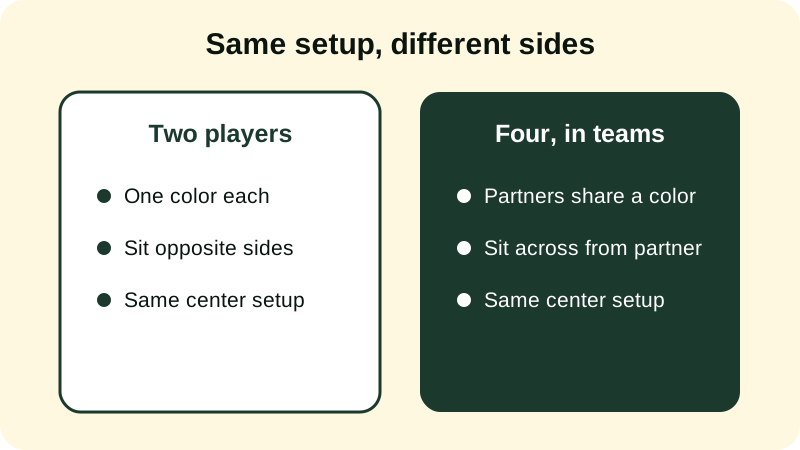
Team play just means partners sit across from each other and share one color between them. This is one of the nicer things about carrom as a family or group game: you don't need a different setup diagram for four players. You place the same 19 coins the same way, then agree on teams and turn order before the first striker shot. For the full breakdown of partner strategy and turn order, carrom doubles rules explained covers it in detail.
How does the queen fit into the diagram, and why is she in the middle?
The queen sits in the center because she's meant to be equally reachable by everyone at the start — no player gets an early angle advantage on her. That center position is exactly why she's tricky to pocket early: she's usually surrounded by other coins on the first few turns, and a rushed shot at her tends to scatter the board instead of connecting cleanly.
Most experienced players wait until the ring around her has thinned out before going for the queen, since a clean line to the center is much easier once a few coins have already been pocketed. For the full detail on what happens the moment you do pocket her — and why pocketing her alone isn't enough to claim her — this breakdown of the queen rule covers it step by step.
What's an easy way to check your setup is correct?
Before the first shot, look at the circle from directly above if you can, or from each baseline in turn. You're checking for three things: the queen is centered, the ring of 18 coins is tight with no gaps, and the colors alternate around her rather than clumping.
| Element | Placement |
|---|---|
| Red queen | Center of the circle |
| White coins (9) | Alternating positions around the queen |
| Black coins (9) | Alternating positions around the queen |
| Striker | Base line, not part of the center stack |
One more small thing worth noting: the coin stack sits on a board with four corner pockets, so however tight your ring is at the center, all four corners should be equally reachable once the break scatters things. That symmetry is really the whole point of a correct coin placement diagram — it keeps the opening of the game fair no matter which side you're sitting on.
Where can you actually practice this without setting up a real board?
A physical board is still the best way to get fast at reading a setup, but if you want a backup between sessions, Carrom — a mobile carrom game currently in development, built around real physics and a promise of no pay-to-win in online multiplayer — is planned to let you set up and break the same 19-coin arrangement on your phone someday. It isn't released yet; get notified when it launches.
Once the setup is second nature, the actual game gets a lot more fun, because you're spending your attention on strategy instead of double-checking whether the coins are arranged right. For more on turns, fouls, and strategy once the board is set, the rest of the blog has the full rundown.
Frequently asked questions
How many coins go in a carrom coin placement diagram?
A full setup has 19 coins total: 9 white coins, 9 black coins, and 1 red queen. The queen sits in the exact center of the circle, and the 18 colored coins alternate around her in a tight, symmetrical ring before the first striker shot.
Does the coin arrangement change for doubles?
No. The same 19-coin arrangement is used whether the game is played by two players or by four players in two teams. Doubles just means partners sit across from each other and share one coin color — the center stack itself never changes.
Why do coins alternate colors instead of grouping together?
Alternating white and black keeps the opening shot fair for both sides. If coins clump by color, one player's coins end up buried while the other's sit exposed near the pockets, which skews the whole game before anyone has taken a real turn.
Should the queen be pocketed early based on the diagram?
Not usually. The queen sits in the center specifically because the ring of coins around her protects her early on. Most experienced players wait until that ring thins out before attempting a cover shot, since a clean line to the center is easier later.
Can I practice carrom coin setup without a physical board?
A real board is still the best training ground, though Carrom, a mobile carrom game in development, is planned to let players set up and break the same 19-coin arrangement once it launches — get notified at the homepage when that happens.