Home › Blog › Carrom Board Markings Explained
Carrom Board Markings Explained
Last updated: October 9, 2026
This article explains what the center circle, base lines, arrow lines, and diagonal lines on a carrom board actually do so players can set up faster and aim more reliably.
Published · Updated
Quick answer
Carrom board markings explained: the center circle holds the coin setup, base lines mark the only legal striker position, arrow lines give a repeatable angle toward each corner, and diagonal lines mark the real approach into each pocket.
Key takeaways
- The center circle holds the coin pattern and queen before each game starts.
- Base lines mark the only legal starting spot for the striker on every shot.
- Arrow lines give a repeatable angle reference toward each corner pocket.
- Diagonal lines near pockets mark the real approach a coin needs to drop in.
- Markings stay identical in doubles — only turn rotation and base-line choice change.
Carrom board markings explained simply: every circle and line on the board exists to help you set up faster and aim better, not just to look traditional. Learn what each one does and the board stops looking busy and starts looking useful.
What do the circles and lines on a carrom board mean?
A standard board has four markings that matter every single game: the center circle, the base lines near each edge, the arrow lines that run toward the corners, and the diagonal lines close to each pocket. They all serve the same basic purpose — giving you a fixed reference point so a shot you line up once is repeatable, not guesswork.
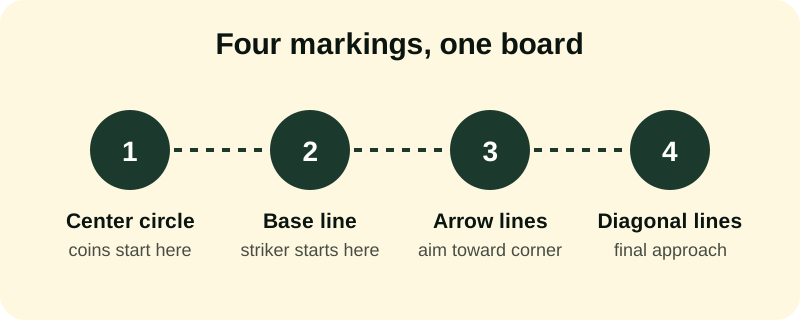
The center circle is the easiest one to spot — it's the large circle right in the middle of the board. Before a game starts, all of the coins sit inside it in a set pattern: 9 white coins, 9 black coins, and the single red queen, 19 coins in total. If you've never set that pattern up yourself, a coin placement diagram is the fastest way to get it right without counting rows every time.
Around that circle, smaller circular or oval marks sit positioned symmetrically near the edges. These aren't decoration — they're reference points players use to describe where a loose coin has landed mid-game, the same way you'd describe a position on a map.
Why does the base line matter when you set up a shot?
The base line is the straight line running parallel to the edge closest to whoever is about to shoot, and it's the only legal starting position for the striker. You can slide the striker left or right along that line to change your angle into the board, but moving it forward off the line before you flick is treated as a foul on most boards.
Because the base line is where every shot originates, it's worth treating it with the same care you give the coins themselves. A striker that's slightly off-line throws off an angle you thought you'd calculated correctly, which is frustrating when the miss had nothing to do with your actual technique. If you're still working on the flick itself, the basics of setup and play are worth revisiting alongside the markings — the two go hand in hand.
What are the arrow and diagonal lines near the pockets for?
Arrow lines run diagonally across the board from roughly the middle toward each corner, and they exist because carrom has no built-in protractor — these lines are the closest thing to one. Lining a shot up against an arrow line gives you a repeatable way to judge an angled shot instead of eyeballing it fresh every time.
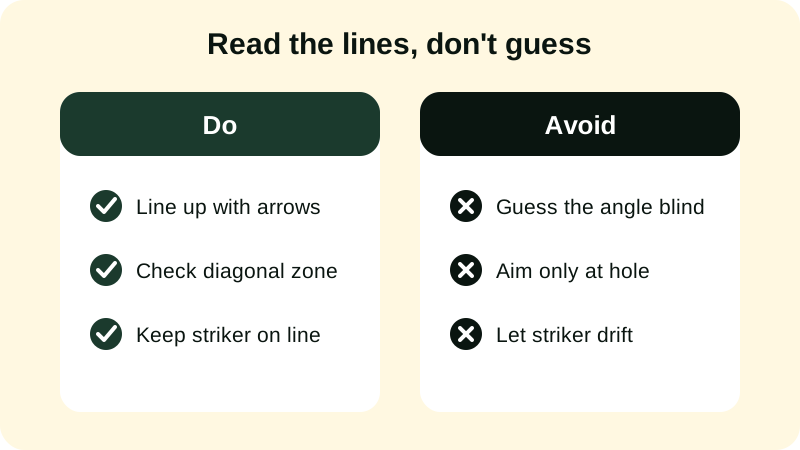
The diagonal lines sitting closer to each of the four corner pockets do a slightly different job — they mark the final approach a coin needs to actually drop in cleanly, rather than clip the edge and bounce back out. A coin that's technically "lined up" with the pocket but sitting outside that diagonal zone often rattles out instead of falling, which is one of the more annoying near-misses in the game once you learn to spot it coming.
Once you're comfortable reading these lines, the next step is tightening your actual aim — a guide to lining up shots builds directly on what the arrow lines are already showing you.
Do the markings change for doubles, or for practicing alone?
The markings themselves never change — the center circle, base lines, arrow lines, and diagonal lines are identical whether the game is played by two players or by four players split into two teams. What changes in doubles is which base line each teammate shoots from and how turns rotate around the board, not the board itself.
If you're new to playing with a partner, carrom doubles rules explained covers how turn order and positioning actually work once the board stays fixed but the rotation doesn't.
Markings only help if you can see them, though. A board that's picked up dust or lost powder over time makes even well-placed arrow lines harder to trust, since you're now compensating for drag on top of judging the angle. A quick pass with a soft cloth and fresh powder — covered in the board maintenance guide — keeps the surface, and the lines on it, doing their job properly.
It's also worth knowing the board's actual footprint if you're shopping for one or building practice habits around it: a standard playing surface measures 74 x 74 cm, with four corner pockets, one at each corner where the diagonal lines point. That scale is part of why the markings exist at all — on a surface that size, eyeballing every angle from scratch isn't reliable, and the lines give you a consistent frame of reference shot after shot. For more on the numbers behind the board itself, the standard board size guide covers the full footprint.
None of this is complicated once you've connected each line to the job it does. If you'd rather rehearse reading these lines on a phone, Carrom is a mobile carrom game in development with realistic physics and no pay-to-win in online multiplayer — get notified when it launches. For more on technique and setup once you're back at a real board, the rest of the blog covers striker play, queen covers, and maintenance in more depth.
Frequently asked questions
What is the circle in the middle of a carrom board for?
The center circle marks where the coins and queen sit before a game starts. All 19 coins — 9 white, 9 black, and 1 red queen — go inside it in a fixed pattern, which is also why it's useful as a reset point when you're setting up a fresh game.
Why can't I move the striker forward off the base line?
The base line is the only legal starting position for a shot, so sliding the striker forward before you flick changes where contact happens without you realizing it. Most boards treat this as a foul, which is why checking striker position matters as much as checking your angle.
Do the arrow lines point exactly where I should aim?
Not exactly, but they give you a fixed reference instead of eyeballing an angle from scratch every time. Lining your shot up against an arrow line makes an angled shot repeatable, which matters more than any single shot being perfect.
Are carrom board markings the same for doubles?
Yes. The center circle, base lines, arrow lines, and diagonal lines don't change whether two players or four players in two teams are playing. What changes in doubles is which base line each teammate shoots from and how turns rotate.
Why do coins sometimes rattle out of a pocket instead of dropping?
That usually happens when a coin lines up with the hole itself but misses the diagonal approach line in front of it. Aiming at that diagonal zone instead of the pocket opening is what actually determines whether a coin falls cleanly or bounces back out.