Home › Blog › How to Organize a Carrom Tournament
How to Organize a Carrom Tournament
Last updated: October 13, 2026
Organizing a carrom tournament comes down to locking in format, bracket size, equipment, and house rules before the first match starts.
Published · Updated
Quick answer
To organize a carrom tournament, lock in the format (singles, doubles, or round robin), bracket size, enough boards and matched strikers, and house rules before play begins. Settling these four decisions early keeps the whole event on schedule.
Key takeaways
- Decide format — singles, doubles, or round robin — before building the bracket.
- One board runs one match at a time, so board count limits how fast the day moves.
- Match striker weight and board surface across every table for fairness.
- Agree on foul calls, turn time, and queen-cover rules before round one.
- Give every match a time limit and keep a staging area ready near the boards.
To organize a carrom tournament, lock in four decisions early: format, bracket size, equipment, and house rules. Settle those before anyone shows up and the rest of the day runs itself.
How do you plan a carrom tournament from start to finish?
Start with the shape of the day before you touch a bracket. Decide the carrom tournament format that fits your numbers — singles knockout, doubles, or round robin — along with roughly how many players you can host, how many boards you'll have running at once, and how much time you've actually got.
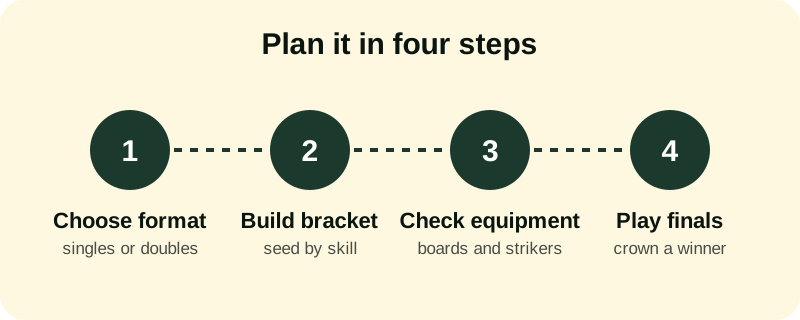
Once you know your numbers, the rest follows in order: settle on singles or doubles, build the bracket around however many players sign up, confirm every board and striker is ready to go, and set aside a clear block of time for the final. Write the plan down and share it with players ahead of time — nobody plays their best carrom when they're also trying to figure out what's happening next.
Should your carrom tournament run singles, doubles, or both?
Singles tournaments are simpler to run and easier to seed. Doubles just need one more layer of planning — pairing partners and giving both players on a side a say in strategy — since carrom is normally played by two players, or by four players in two teams.
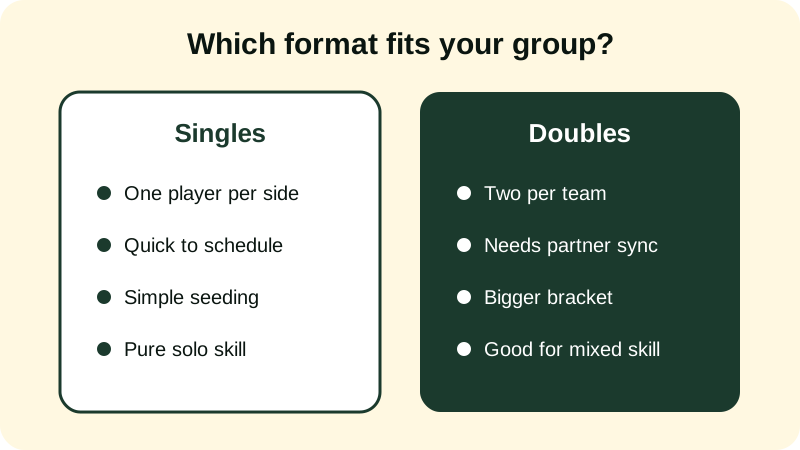
If your group is mixed in skill, doubles tournaments are often the friendlier format — a strong and a weaker player can team up, and the format rewards partner communication as much as raw shot-making. If you want players to practice doubles strategy before tournament day, this guide to carrom doubles rules covers how turns, partners, and positioning actually work.
How many boards and sets of equipment do you need?
One board can realistically run one match at a time, so the number of boards you can set up is the single biggest limit on how fast your carrom tournament bracket moves. Each set needs a full complement of coins — the standard arrangement is 9 white coins, 9 black coins, and 1 red queen, for 19 coins total — plus a striker for each side.
If you're borrowing boards from different households, expect small differences in glide even if every surface is the same 74 x 74 cm playing area with four corner pockets — some will be faster, some slower, depending on how recently they were powdered. A quick pass with a standard board maintenance routine before the tournament starts levels the playing field more than almost anything else you can do.
How do you build a fair carrom tournament bracket and keep score?
A simple knockout bracket is the fastest way to run a tournament with a lot of players and limited time, since every match eliminates someone and the field shrinks quickly. With fewer players and more time, a round-robin format — where everyone plays everyone — gives a fairer overall result, since one unlucky match doesn't end your tournament.
- Collect sign-ups and confirm singles or doubles pairings before the draw.
- Seed players or teams by skill if you can, so the strongest meet later, not first.
- Draw the bracket and post it somewhere every player can see it.
- Assign specific boards to specific matches so nobody's wandering looking for a table.
- Record each result immediately and update the bracket before the next round starts.
- Set aside a dedicated block of time for the final, with no other matches competing for attention.
What carrom tournament rules should everyone agree on before round one?
Carrom has a few spots where house rules genuinely vary from table to table — how strictly fouls are called, how much time a player gets per turn, and exactly how the queen must be covered. Settle all of it out loud before round one, in front of everyone, not quietly between the organizer and whoever happens to ask first.
If some of your players are newer to the game, point them toward a full rules and setup guide and an explanation of what happens when the queen is pocketed ahead of time, so the tournament itself isn't anyone's first lesson. A shared understanding of the queen rule alone prevents more arguments than any other single thing on tournament day.
How do you keep a carrom tournament running on time?
Give every match a time limit, even a generous one, and announce it before the round starts — open-ended matches are the single biggest reason tournaments run late. Keep a staging area near the boards so the next pair of players is always ready to step in the moment a match ends, instead of a five-minute gap while someone goes looking for them.
If you'd rather warm up digitally between matches, Carrom — a mobile carrom game in development, built around real physics and a promise of no pay-to-win in online multiplayer — isn't released yet, so there's nothing to download today. You can get notified when it launches and use it to drill shots between your own tournament rounds.
Run it once with a clear format, enough boards, and the rules settled up front, and your carrom tournament will feel less like herding cats and more like the event everyone asks you to run again. More carrom guides are on the blog if you want to prep further before tournament day.
Frequently asked questions
How many players do you need for a carrom tournament?
Since carrom is played by two players, or by four players in two teams, any multiple of that works. Small groups can run a quick round robin, while larger groups usually suit a knockout bracket since it eliminates players quickly and finishes within a set block of time.
Is knockout or round robin better for a carrom tournament?
Knockout is faster and works well with a lot of players and limited time, since every match removes someone. Round robin, where everyone plays everyone, is fairer but takes longer, so it suits smaller groups or events with a full day set aside.
What equipment should organizers prepare ahead of time?
Each board needs a full coin set — 9 white coins, 9 black coins, and 1 red queen, for 19 coins total — plus a matched striker per side. Checking every board's surface and powder level beforehand keeps play consistent from table to table.
How do you avoid arguments over carrom rules mid-tournament?
Agree on foul calls, turn time, and how the queen must be covered out loud, in front of everyone, before round one starts. Pointing newer players to a rules guide ahead of time also helps, so the tournament itself isn't their first introduction to the game.