Home › Blog › History of Carrom: Where the Game Began
History of Carrom: Where the Game Began
Last updated: October 17, 2026
A look at carrom's folk origins, how it spread from homes to clubs and tournaments, how the board standardized over time, and where the game is headed next.
Published · Updated
Quick answer
Carrom has no confirmed birthplace or date — the history of carrom points to homemade South Asian boards generations ago, later spreading into clubs, tournaments, and now mobile apps.
Key takeaways
- Carrom has no single confirmed origin story — most accounts trace it to South Asian homes.
- The game spread by word of mouth, from households to local clubs and tournaments.
- A standard board today has 19 coins, four pockets, and a 74 x 74 cm surface.
- Carrom is now moving onto mobile apps, with Carrom (not yet released) in development.
- House rules still vary by region — there's no single correct version of carrom's past.
The history of carrom has no single confirmed start date, and that's part of its charm. Most accounts trace it back generations to South Asia, where it began as a homemade tabletop game long before anyone wrote its rules down.
Where did the carrom board game actually come from?
Nobody kept a dated record of the first carrom board, which is exactly why the origins of carrom are still debated among players and enthusiasts today. The most common thread places it in South Asia, where families built or commissioned glass-topped or polished-wood boards for home play, long before anything like a carrom board was sold in stores.
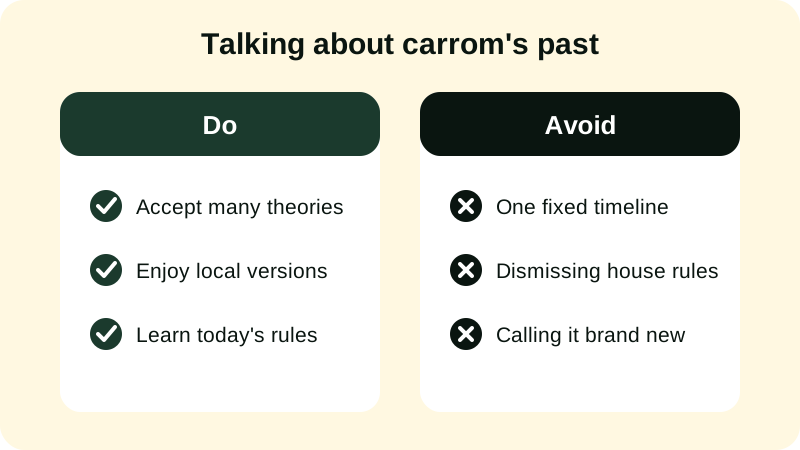
Ask how old is carrom and you'll get a different answer from almost every household — "my grandparents' grandparents played this" is a common refrain across regions. What's consistent across those stories is that it started informal and homemade, long before anyone organized it into clubs or competitions, and that board material, finish, and even coin shapes varied from house to house depending on what was on hand.
That looseness is a decent argument for calling carrom folk-made rather than invented by any one person or workshop. It grew the way household games tend to grow: someone built a board, the neighbors wanted one too, and it spread by word of mouth and imitation rather than through a patent or a factory line. That same informal spirit is why so many regions still argue, half-seriously, about whose family played the "original" version — and why none of those claims really need to cancel each other out.
How did carrom spread and change over the decades?
From those early homemade boards, the evolution of carrom followed a familiar path for folk games — households taught neighbors, neighbors taught towns, and eventually enough people were playing that informal matches started turning into something more organized.
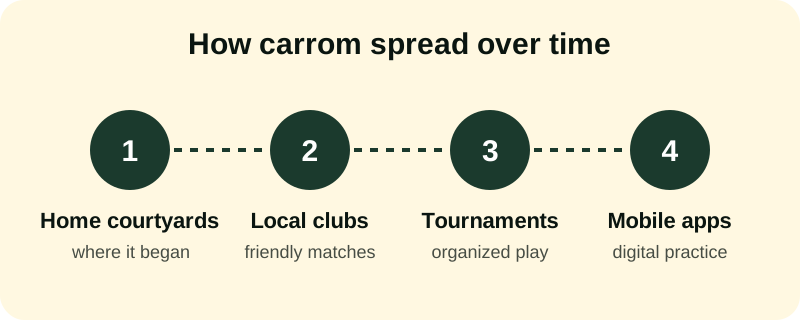
Standardization mattered most once carrom moved beyond the living room. A board that worked fine for a casual family game needed consistent dimensions and a predictable coin count once neighboring towns started playing each other, and that pressure is a big part of why today's board looks the way it does, rather than varying wildly from house to house the way it once did.
Boards once built from whatever local wood a household could manage have given way to sturdier, more consistent options over time. The game also picked up its own house rules in every place it reached, which is why two households can still swear they're both playing it "the right way" while disagreeing on the details. If you want the version most players agree on today, the guide to carrom rules for beginners is a solid place to start.
Carrom also turned out to be a natural fit for big families and gatherings — it only takes a flat surface and a handful of coins to get a real game going, and it works just as well with two players as it does with four split into teams. That flexibility is part of why it never really needed marketing to spread, and why it's stuck around as a staple for family game nights; if you're introducing a new generation to it, the guide to teaching kids to play carrom covers how to start them off right.
What does a modern carrom board look like compared to earlier versions?
Whatever shape a traditional carrom board took in someone's living room a generation or two ago, today's version has settled into a fairly consistent standard that most serious players recognize anywhere they travel.
| Component | What's on a standard board |
|---|---|
| Playing surface | 74 x 74 cm |
| Pockets | Four corner pockets |
| Coins | 19 total — 9 white, 9 black, and 1 red queen |
| Striker | Weighs 15 grams |
| Players | Two, or four split into teams |
That standard setup is worth knowing cold before a serious game, since it's what most opponents will expect no matter where you're playing. For the exact layout of where each coin goes before the first shot, the coin placement diagram walks through it, and the standard carrom board size guide has more on dimensions if you're buying or building one.
The surface itself carries its own small history. Early boards relied on whatever polish or wax a household had on hand, while today most serious players stick to a consistent approach for keeping the surface fast and predictable — a world away from improvising with whatever was in the cupboard a generation ago.
Is carrom still evolving, and where is it headed next?
Carrom hasn't stood still just because the board settled into a standard. Local clubs still run informal tournaments, families still treat it as the default rainy-day game, and the newest chapter in its evolution has nothing to do with wood or powder at all — it's showing up on phones.
Carrom, an app currently in development, is being built around the same real physics and skill the tabletop game rewards. It's designed around no pay-to-win in online multiplayer, with strikers and board themes kept cosmetic so nothing bought gives an edge against another real player. It isn't released yet, but once it is, it's meant to offer local pass-and-play, online multiplayer, and a handful of AI opponents at different difficulty levels for solo practice; get notified when it launches if that's of interest.
Online multiplayer is the part most directly tied to carrom's history of spreading by imitation — instead of a neighbor teaching a neighbor, it's one player challenging another from across a city or a country. Whatever form carrom takes next, its whole history has been about adapting to whoever is playing it — a courtyard, a classroom, a tournament hall, or eventually a screen. For more of the game's rules, setup, and strategy, the blog is the place to keep digging, and if carrom is just one of several games you're considering for a get-together, classic board games to play indoors rounds up other options worth comparing.
Frequently asked questions
How old is carrom, really?
There's no confirmed date for carrom's creation, which is part of why how old is carrom is still debated. Most accounts trace it back many generations to South Asian households, where boards were built at home and passed down rather than documented, so the real age is closer to folklore than recorded history.
Did carrom start as a home game or an organized sport?
It started as a home game. Households built or commissioned their own boards long before clubs, tournaments, or any standardized ruleset existed. Organized play came later, once enough people were playing that informal matches naturally turned into club and tournament competition.
How did the carrom board change over time?
Early boards varied by household in material, finish, and even coin shape. Over the decades the game settled into a consistent standard — a 74 x 74 cm surface, four corner pockets, 19 coins, and a 15-gram striker — so players could expect the same setup wherever they played.
Is there a digital version of carrom?
Carrom, a mobile app, is in development but not released yet. It's being built around real physics with a promise of no pay-to-win in online multiplayer, plus planned local pass-and-play and AI opponents; you can get notified when it launches from the homepage.
Why do carrom rules differ between families or regions?
Because the game spread informally, by word of mouth rather than a single rulebook, local house rules took hold in every place it reached. Those variations are part of carrom's charm — most differences are small, and the widely agreed version is a good starting point for new players.