Home › Blog › The Best Way to Learn Carrom Fast
The Best Way to Learn Carrom Fast
Last updated: October 18, 2026
A practical, stage-by-stage plan for learning carrom quickly by mastering setup, straight shots, angles, and the thumb shot before playing full games.
Published · Updated
Quick answer
The best way to learn carrom fast is to practice one skill at a time in a fixed order — setup and rules, then straight shots, then angles, then the thumb shot — instead of jumping straight into full games.
Key takeaways
- Learn in stages: setup and rules, straight shots, angles, then the thumb shot.
- Drill one skill per session until it feels boring before moving on.
- The thumb shot is the single highest-value shot to master early.
- Rushing into full games before straight shots are solid is the top beginner mistake.
- A mismatched striker weight can undo an otherwise correct shot.
The best way to learn carrom fast is to practice one skill at a time, in a fixed order — setup and rules first, then straight shots, then angles, then the thumb shot — instead of jumping into full games before you can pocket coins consistently from close range.
What's the right order to learn carrom skills in?
Most beginners try to play a full game before they can land a straight shot, which is why progress feels slow no matter how often they play. Learn in stages instead, and don't move to the next stage until the current one feels almost boring.
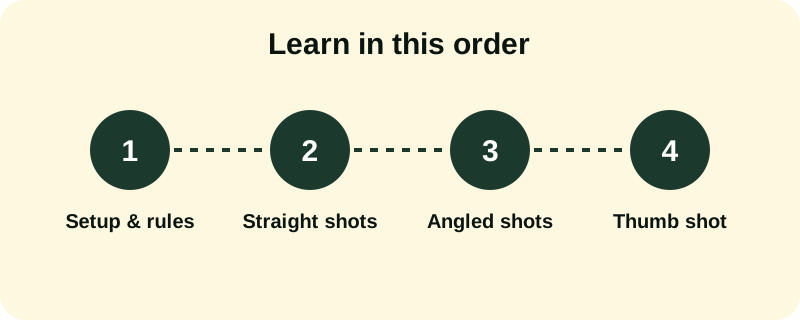
Start with the board itself: how the coins get arranged, what the rules of a turn actually are, and what happens once the queen gets involved. This stage is the fastest part of the learning curve, since it's pure memorization rather than feel — the rules and setup basics and a clear coin placement diagram are worth locking in before you take a single serious shot. Knowing what counts as a foul, what happens if the striker leaves the board, and how covering the queen works will save you from relearning habits later that only feel wrong once you're deeper into the game.
Once setup and rules are automatic, move to straight shots taken directly in line with a pocket from close range. Only once those feel easy should you add angles, and only once angles feel natural should you bring in the thumb shot. Each stage builds the control the next one needs — skip ahead and you'll spend weeks fighting a technique problem that was actually a fundamentals problem in disguise.
A sensible carrom beginner training plan spends most of its early time on the first two stages, because a shaky straight shot makes every later skill harder to judge honestly. If you can pocket a coin from a straight line almost without thinking, you're already ahead of most players who jumped straight to fancier angles. It's not the most exciting part of learning carrom, but it's the part that quietly determines how fast everything after it goes.
What does a fast, effective practice session actually look like?
If you're wondering how to improve at carrom quickly, the answer is almost always the same: isolate one skill, drill it until it's boring, then move on. Figuring out the fastest way to learn carrom usually comes down to deliberate practice, not raw hours at the board.
- Warm up with a handful of straight shots directly in front of a pocket until your hand feels settled.
- Add one angled shot — ideally the exact angle that gave you trouble last session.
- Drill the thumb shot on its own, from a stationary position, before mixing it into anything else.
- Set up a short scenario with the queen exposed and practice the cover shot that follows it.
- Review the miss before you shoot again — figure out why it happened, not just that it did.
You don't need an opponent for most of this. A solo training guide walks through drills built for exactly this kind of repetition, and getting your aim consistent first is worth doing before anything else, since sloppy aim makes every other skill feel inconsistent too. If you usually play as part of a team, doubles rules are worth knowing early as well, since partner strategy changes which shots are actually worth drilling in the first place.
Which single shot speeds up your progress the most?
If you only drill one thing this week, make it the thumb shot — it shows up constantly in real games, and most beginners avoid it early because it feels awkward at first.
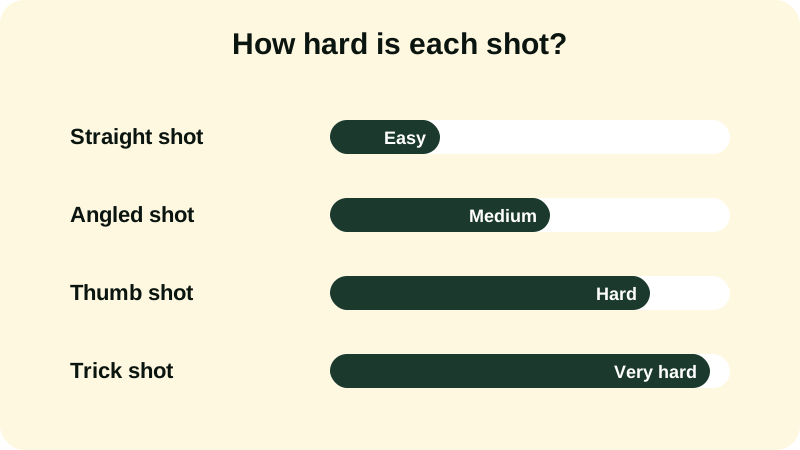
The thumb shot lets you strike without lifting your hand off its resting position, so your base stays steady and you're ready for the follow-up shot immediately. A step-by-step breakdown of the grip and release will get you there faster than guessing on your own, and it's worth drilling on its own before you ever try to use it mid-game.
Once the thumb shot feels natural, angled cut shots are the logical next challenge, since many real-game positions won't offer a clean straight line to the pocket. Treat it as its own stage rather than something you'll just absorb during a match — it rewards the same deliberate, one-skill-at-a-time approach as everything before it, and it's where most of the "lucky" shots you see good players make actually come from.
What mistakes slow beginners down the most?
The fastest way to lose weeks of progress is to practice a bad habit until it feels normal. Real speed comes from correcting errors early, not from logging more games with the same flaw baked in.
A rundown of the specific fouls and technique errors that quietly cap most beginners' progress is worth reading early, before those habits have a chance to set in. Once your fundamentals are solid, a real strategy guide is where learning starts to pay off in actual wins instead of just cleaner-looking shots.
You won't learn carrom in a week by simply playing more matches — you'll get there by treating practice and real games as two separate activities for a while, at least until the fundamentals stop needing conscious thought. Casual games are great for fun and for testing what you've drilled, but they're a poor place to actually fix a flaw, since there's always pressure to just finish the turn instead of stopping to figure out what went wrong.
If you want somewhere to run all of this without needing a second player standing by, Carrom is being built around five AI difficulty levels, with AI matches and local pass-and-play designed to work without needing an internet connection once it launches. It isn't released yet, but you can get notified when it launches — and in the meantime, the rest of the blog has more technique guides worth working through.
Frequently asked questions
What's the fastest way to learn carrom?
Learn in a fixed order instead of playing full games right away: setup and rules first, then straight shots, then angles, then the thumb shot. Drilling one skill at a time until it feels automatic beats scattered practice and is the biggest single lever for progressing quickly.
How long does it take to see real improvement?
Most players notice a real jump within a handful of focused practice sessions, especially once straight shots and aim stop requiring conscious thought. Progress speeds up fastest when each session targets one specific weakness instead of just playing casual games against whoever is around.
Do I need a partner to practice effectively?
No. Most of the drills that matter most early on — straight shots, the thumb shot, queen cover shots — can be practiced solo against an empty board. A partner helps once you're ready for angle variety and doubles strategy, but isn't required to build fundamentals.
Does the Carrom app help with learning faster?
Carrom isn't released yet, but it's being built with five AI difficulty levels, and AI matches plus local pass-and-play are being designed to work without needing an internet connection once it launches. Online multiplayer is planned with no pay-to-win in online multiplayer, so skill decides those matches. You can get notified at launch from the home page.